The Volta effect

The Volta effect arises from the study of contact between metals. Through a series of observations and laws, Volta clarified the conditions necessary for the production of a permanent electric current, laying the foundations of electrochemistry.

The discovery of the Volta effect

The study of the contact voltage between two or more metals connected in a circuit led Volta to discover what we now call the Volta effect.

Dry and wet conductors

The scientist then established a distinction between first-class conductors (dry conductors, i.e. metals) and second-class conductors (wet conductors, i.e. solutions of acids, bases and salts).

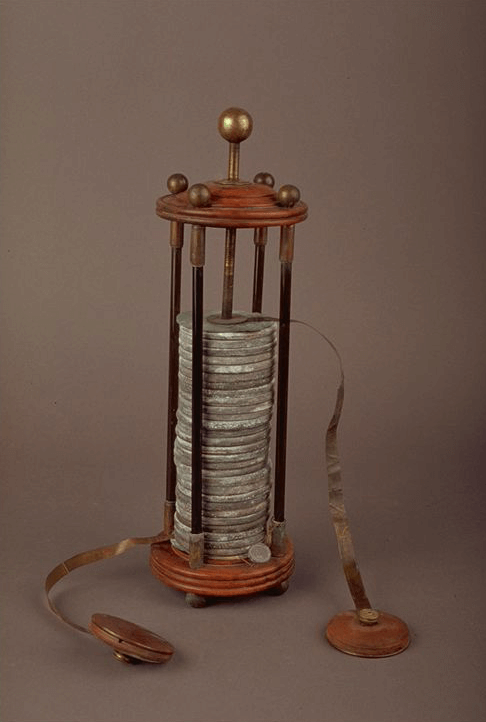
Column battery with electrodes (Voltiano Temple)
Pila a colonna con elettrodi (Tempio Voltiano)

Three key results

Three fundamental findings During his dispute with Galvani, Volta acquired these fundamental findings:

  • The first concerns the electrical imbalance at the point of contact between two different metal conductors, i.e. the latter discovery; correctly interpreted, this can be traced back to the so-called “Volta effect”, which, in today’s terms, refers to the fact that an electrical potential difference is established between the external points of two different metals in contact with each other.
  • The second concerns the impossibility of producing a permanent electric current in closed circuits consisting solely of different metals and in any number a priori.
  • The third, which states that when a wet conductor (e.g. cardboard soaked in salt water) is inserted between two different metals – or, reciprocally, if a metal conductor is inserted between two different wet metals – that is, a system of three different conductors in contact is created to form an open “single voltaic element”, and then the two metals are brought into contact with each other (e.g. by means of a wire of the same type as one of the two), a permanent electric current is established in the closed arc thus formed.

The laws of contact

From these observations, three laws can be derived:

  • first law: contact between two different metals at the same temperature causes a potential difference characteristic of the nature of the metals to be established, which does not depend on the extent of the contact (Volta effect)
  • Second law: in a chain of different metal conductors placed at the same temperature, the potential difference between the two extreme metals is the same as it would be if they were in direct contact.
  • Third law: between two metals of the same nature there is a potential difference if they are the ends of a chain of conductors comprising two different metals with a second-class conductor interposed between them.
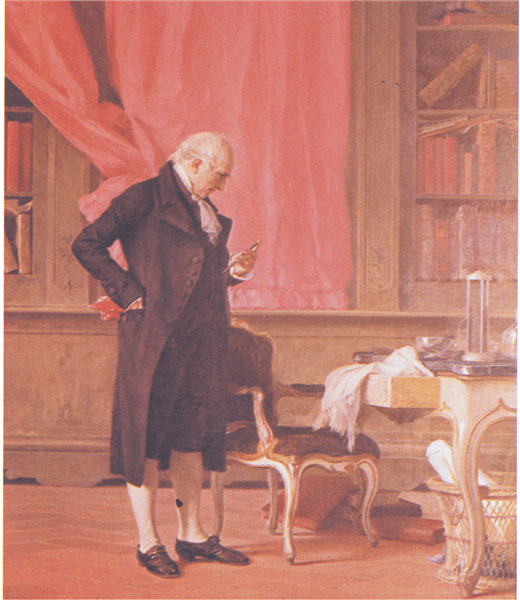
Volta in his studio (oil painting by Nicolò Barabino, 1832–1891, Genoa, Palazzo Orsini Spalletti-D’Albertis)
Volta nel suo studio (olio di Nicolò Barabino, 1832 1891, Genova, Palazzo Orsini Spalletti D’Albertis)

The order of metals

The second law was first stated in November 1801, during the presentation of the battery at the Institute de France. It is presented as a necessary consequence of the property that metals have of being able to be ordered according to their ability to push or pull electrical fluid.