Methane

In 1776, Volta observed and studied a gas emerging from the marshes of Lake Maggiore. By identifying its properties, he discovered methane and intuited its possible applications, contributing decisively to the development of gas chemistry.

A new ‘air’

In July 1776, Volta presented his Thesis on Aerology, the first sign of a systematic interest in the study of gases. During those years, thanks in part to a dense network of scientific relationships and correspondence, the scientist from Como began a series of observations that would lead him to a completely new discovery.

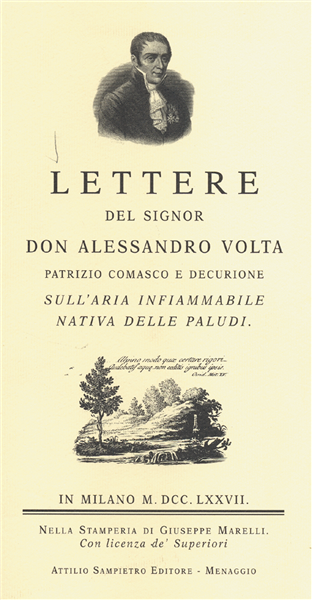
Title page of Letters on the flammable air of marshes (Milan, 1777)
lettere del singor alessandro volta sull aria infiammabile nativa delle paludi

The bubbles of the marshes

During the summer of 1776, while sailing along the reed beds near Angera on Lake Maggiore, Volta observed a curious phenomenon: poking the muddy bottom of the water with a stick, he saw numerous gas bubbles rising to the surface, which quickly vanished into the air once they emerged. He collected the gas and began to study it systematically.

A flammable gas

Volta discovered that the gas collected was flammable and described it as burning slowly with a blue flame. He soon realised that it was a substance different from the flammable metallic air (hydrogen) already known at the time, clearly distinguishing its physical and chemical properties.

The flammable air of the marshes

Volta named this new substance “flammable air native to marshes”. In a series of letters addressed to Father Campi between 1776 and 1777, the scientist expounded his theory and combustion experiments, which were then published in Milan in 1777. This is what we now call methane, the discovery of which is therefore attributed to Volta.

Incipit of the First Letter on the flammable air of marshes (1777)
Incipit della Prima Lettera sull’aria infiammabile delle paludi

Experiments and tools

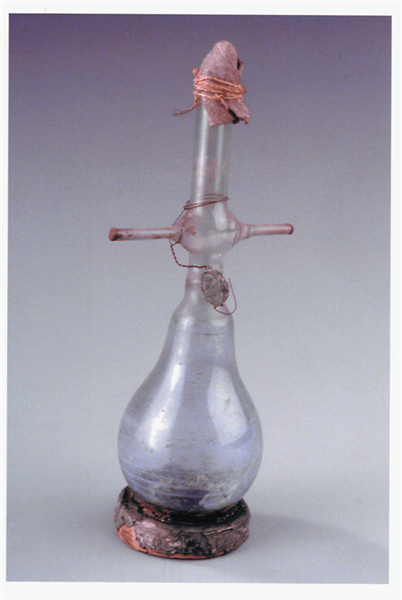
To study and demonstrate the properties of gas, Volta designed specific instruments, including a pistol and a musket that could be fired using flammable air, ignited by a spark obtained from an electrophorus. These experiments, also documented in drawings and letters, once again demonstrate his ability to combine theoretical observation with practical application.

Volta’s pistol (Volta Museum, Como)
pistola di volta

A discovery with future prospects

Volta verified that flammable air was present in all marshes and attributed its origin to decomposition processes. He also intuited possible practical uses for the gas, imagining its economic use as a source of energy. Although many of these applications remain at the project stage, the discovery of methane marks a fundamental step in the history of the chemistry and physics of gases.