The capacitor and the capacitance electrometer

From the condenser to the capacitance electrometer, Volta developed instruments capable of accumulating and making visible very weak charges, paving the way for the study of contact electricity and the battery.

The idea of condensation

Around 1780, Volta observed that the charged shield of an electrophorus, when placed on weakly conductive materials such as marble or wood, retained electricity better than when isolated in air. He thus understands that the charge attracted to the surface of the support induces an opposite charge on the facing surface of the shield.

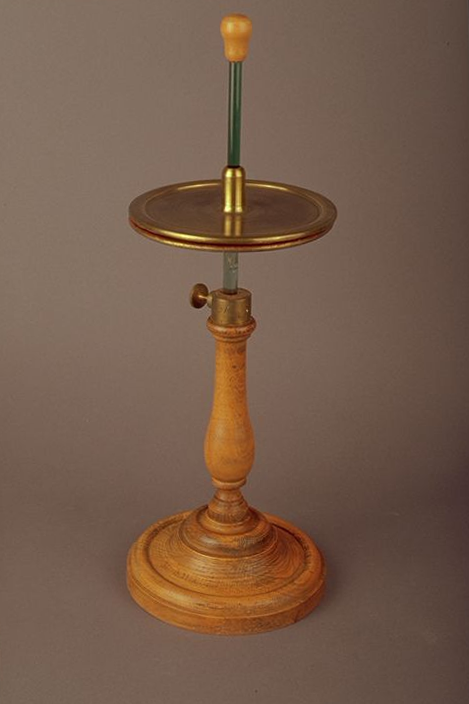
Condenser on pedestal with brass plate and shield covered with a thin layer of sealing wax (Voltiano Temple)
Condensatore su piedistallo con piatto di ottone e scudo coperto da sottile strato di ceralacca (Tempio Voltiano)

The electricity capacitor

This observation led to the invention of the electric capacitor: two identical metal discs, superimposed and separated by a thin insulating layer. One is fixed to an insulating pedestal, the other is equipped with a handle, like the shield of the electrophorus. The insulating paint prevents direct contact between surfaces.

Charges without transmission

When one of the two discs is charged while the other is grounded, a charge of opposite sign is induced without direct passage of electricity. The opposite charges remain ‘condensed’ on the facing surfaces of the discs thanks to their mutual attraction and become observable only when the plates are separated.

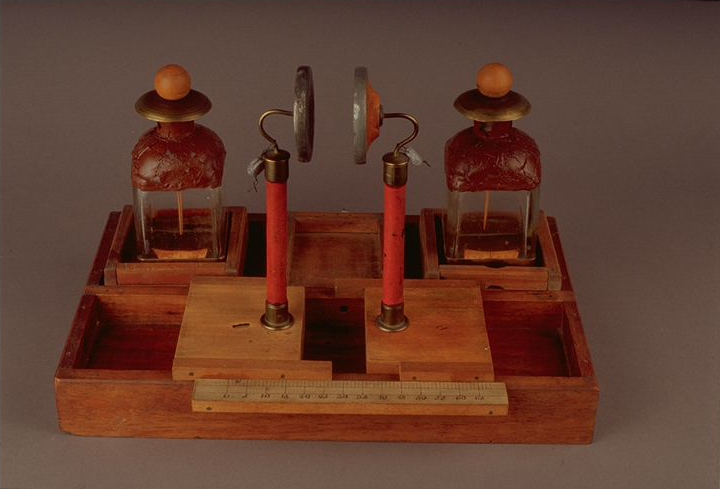
Apparatus for studying conjugate conductors and the dependence of capacitance on the distance between plates (Tempio Voltiano)
Apparato per lo studio dei conduttori coniugati e della dipendenza della capacità dalla distanza delle armature (Tempio Voltiano)

From condensation to measurement

By applying the principle of the capacitor to a straw electroscope, Volta created the capacitor electrometer. The rod of the electroscope supports a metal disc coated with insulating paint, on which a second disc with an insulating handle is placed. The addition of discs greatly increases the sensitivity of the instrument.

Capacitor electroscope
Elettroscopio condensatore

Making weak positions visible

During electrification, opposite charges accumulate on the discs but remain invisible as long as they remain in contact. When the upper disc is removed, the constraint is broken, the fluid is redistributed in the electroscope and the straws diverge, making extremely weak electrifactions perceptible.

Design of the capacitor electroscope (detail)
Disegno dell'elettroscopio condensatore (particolare)

A decisive tool

With the capacitor electrometer, Volta was able to detect the weak opposite charges produced when different metals come into contact. This discovery marked the starting point for research into contact electricity and led directly to the invention of the battery.