Electrometry and electrology

Through electrometry, Volta makes electricity measurable. By improving instruments and defining relationships between charge, capacity and voltage, he laid the foundations for modern electrical metrology and anticipated fundamental laws of electrical attraction.

A neglected science

Starting in the 1780s, Volta devoted himself systematically to electrometry, a branch of science that had been little developed until then. Interest also stems from studies on electrical meteorology and the need to make weaker electrical phenomena observable and comparable.

Electrophoretic condenser (Tempio Voltiano, Como)
Elettroforo condensatore – Tempio Voltiano, Como

Making electricity visible

Volta began by modifying the electroscopes in use, increasing their sensitivity. The decisive step is the introduction of the capacitor, which, when combined with electrometers, allows electrical charges to be amplified and measurement accuracy to be dramatically improved.

Fire, air and electricity

In 1782, Volta, together with Lavoisier and Laplace, studied the electrification of air and the causes of natural phenomena such as fires in the ground and burning fountains. This research is compiled in memoirs and writings that testify to the breadth of his scientific interests, spanning physics, chemistry and natural phenomena.

Volta’s autograph: introduction to the 1764 poem on gunpowder, thunder gold and will-o’-the-wisps (Cart. Volt. B. I., Lombard Institute)
Autografo di Volta sui fuochi fatui e la polvere pirica (Istituto Lombardo)

Charge, capacity and voltage

Based on Cavendish’s research, Volta clarified the relationship between charge, capacity and voltage, expressed in the equation Q = C · V. In 1782, with his paper On the Way to Make the Weakest Electricity Sensible, he laid the foundations for theoretical and experimental electrical metrology.

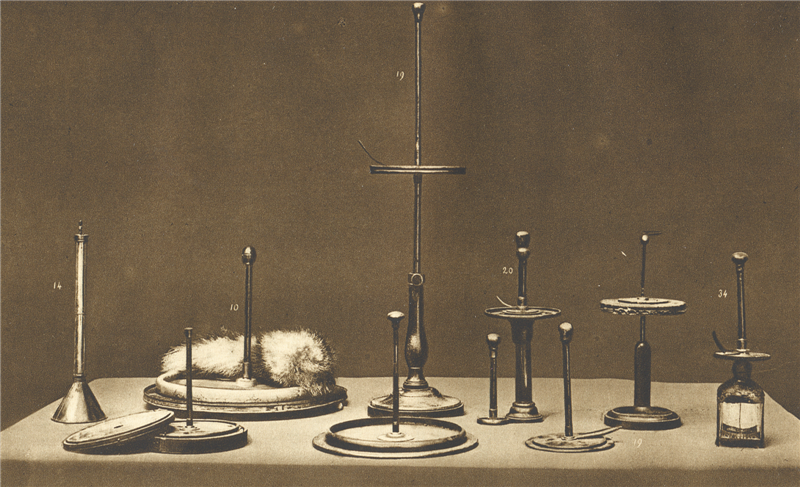
Various examples of electrophoresis and electrometers, capacitors and eudiometers (Photograph, 1899)
Diversi esemplari di Elettrofori ed Elettrometri condensatori ed Eudiometro (Fotografia, 1899)

Towards a universal measure

A central objective of Voltaic electrometry is the definition of a unit of measurement for voltage. Volta proposes to evaluate it through the repulsive force between two charged plates placed at a fixed distance, finally making different measurements comparable.

The laws of electrical attraction

The experiences gained from calibrating the electrometric balance led Volta to formulate fundamental laws on electrical attraction: the force is proportional to the square of the voltage and inversely proportional to the square of the distance. These results anticipated subsequent formulations and consolidated the modern experimental method.