Istituto Lombardo

The Lombard Institute, founded in 1797 by Napoleon on the model of the Institut de France, promoted science, arts, and culture, reflecting the Enlightenment ideal of unified knowledge.
Via Borgonuovo, 25
20121 Milano

A Napoleonic institution

The Lombard Institute was founded in 1797 by Napoleon Bonaparte on the model of the Institut de France, with the task of collecting and promoting scientific discoveries, arts, and culture. The regulations provided for retired and honorary members, divided into sections dedicated to science, moral disciplines, and fine arts, reflecting the Enlightenment ideal of unified knowledge.

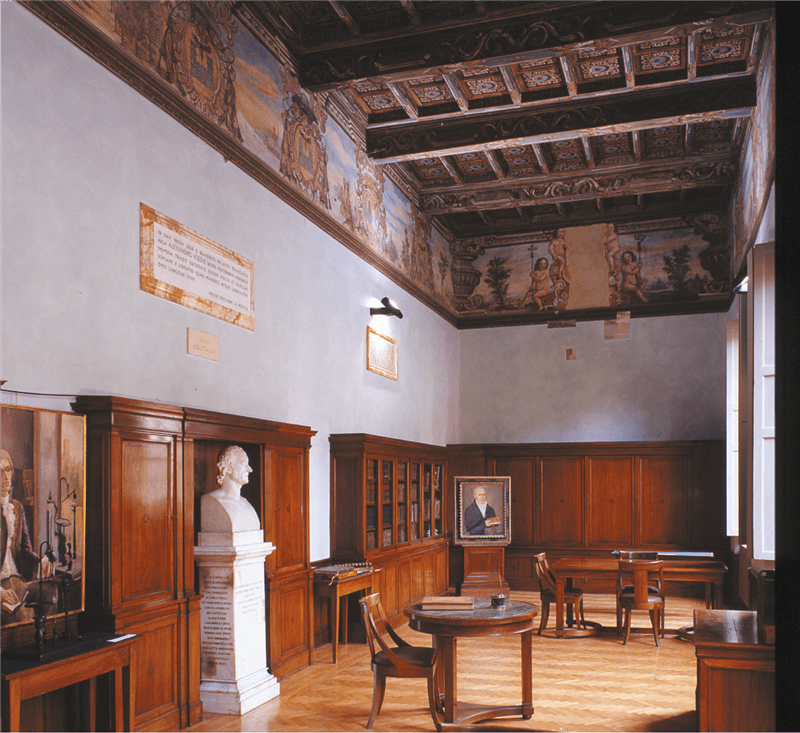
The Volta Room at Palazzo Landriani, the new headquarters of the Lombard Institute

One of the first members

On November 6, 1802, Bonaparte appointed the first members of the Institute, including Alessandro Volta. Official activity began in 1803, and in 1804 the organic regulations were approved. Volta was appointed first President, a role that confirmed his scientific and institutional prestige at European level.

From Bologna to Milan

In 1810, at the request of its members, Napoleon reorganized the institution under the name of Institute of Sciences, Letters, and Arts, establishing its headquarters in Milan, initially in the Palazzo di Brera. After Napoleon’s fall, the Institute continued its activities under Austrian rule and, from 1859, under Italian rule, without ever interrupting its cultural function.

Reading room of the Lombard Institute, Milan
Sala di lettura dell'Istituto Lombardo, Milano

A centuries-old continuity

In 1935, the Institute adopted a new statute and gained administrative autonomy, while remaining under ministerial control. This institutional continuity makes the Lombard Institute one of the longest-running scientific and cultural academies in Europe, active from the 18th century to the present day.

The two classes

The Institute is divided into two classes: Mathematical and Natural Sciences and Moral Sciences. There are currently over three hundred members representing a broad spectrum of scientific and humanistic knowledge, in keeping with the organization’s original vision.

Library and archive

The Institute’s documentary heritage is of extraordinary importance: a library with over 400,000 volumes and a vast archive of manuscripts and documents. Of exceptional scientific and historical value is the rich collection of Volta manuscripts, which makes the Lombard Institute one of the main centres for the study of Alessandro Volta’s work.